At Excelbeyondborders, we know that studying abroad can be both exciting and overwhelming. The journey from application to acceptance in the US, UK, or Canada involves careful planning and decision-making.
This comprehensive guide will walk you through the key steps of choosing the right country and university, navigating the application process, and financing your education abroad.
Let’s explore how you can turn your international education dreams into reality.
How to Choose Your Study Destination
Understanding Education Systems
The US, UK, and Canada offer distinct educational experiences. US undergraduate programs last four years, emphasizing liberal arts in the first two. The UK provides three-year bachelor’s degrees with immediate specialization. Canada’s system blends these approaches, with most programs lasting four years and some completed in three.
US universities allow students to explore various subjects before selecting a major. UK universities require students to choose their field of study at application. Canadian universities offer a balance, providing some flexibility in course selection.
Cost Considerations
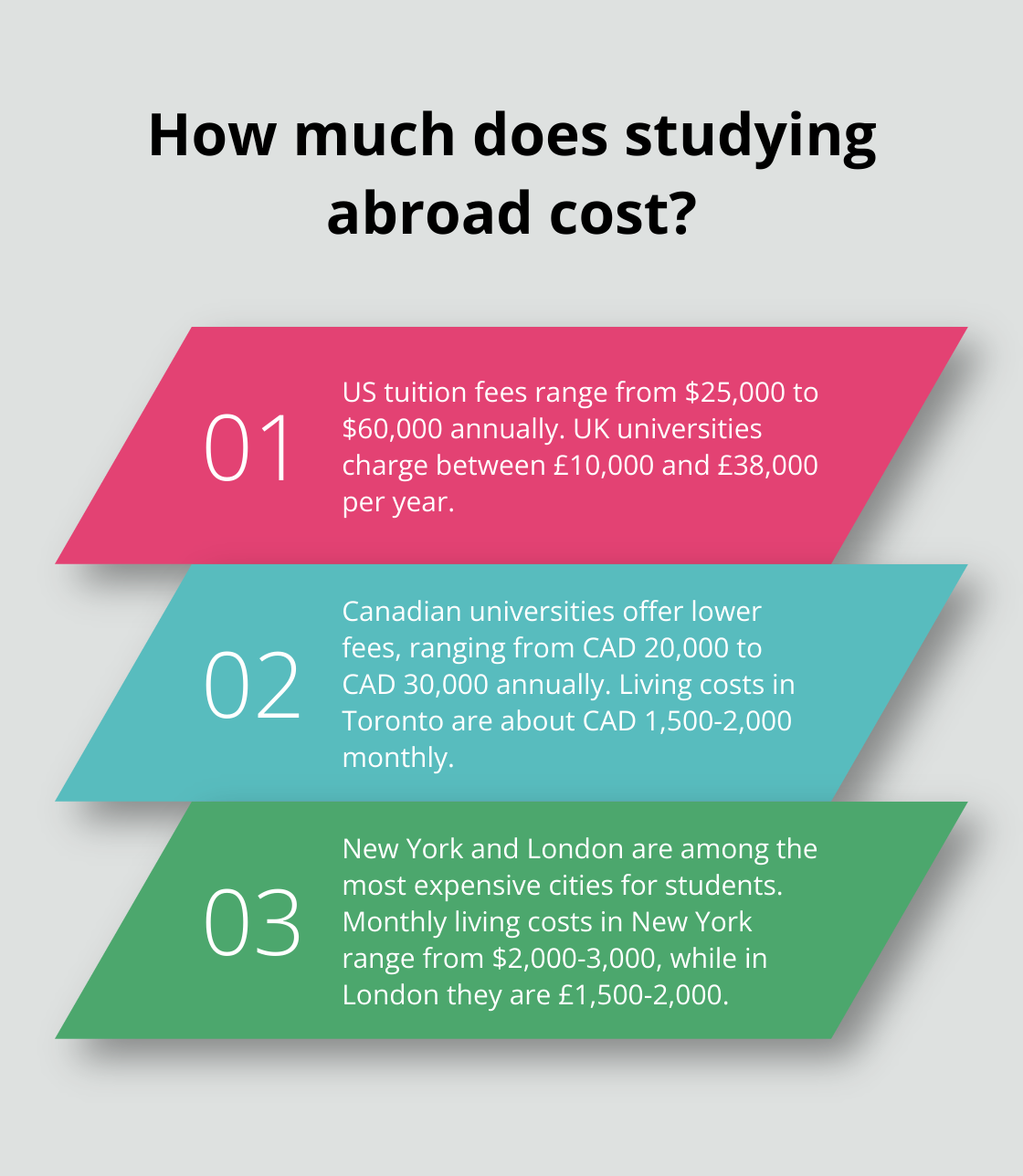
Tuition fees and living expenses differ significantly among these countries. Recent data shows average annual tuition for international students in the US ranges from $25,000-$35,000 for public universities and $30,000-$60,000 for private institutions. UK universities charge between £10,000 and £38,000 per year. Canadian universities generally offer lower fees, ranging from CAD 20,000 to CAD 30,000 annually.
Living costs also vary. New York and London rank among the most expensive cities globally, while many Canadian cities provide a more affordable lifestyle. For example, a student in Toronto spends about CAD 1,500-2,000 monthly on average, compared to $2,000-3,000 in New York or £1,500-2,000 in London.
Job Prospects and Work Opportunities
Post-graduation work opportunities play a crucial role in decision-making. The US offers Optional Practical Training (OPT), allowing certain F-1 students who receive STEM degrees to apply for a 24-month extension of their post-completion OPT. The UK recently introduced the Graduate Route, permitting international graduates to work for two years (three for PhD graduates). Canada’s Post-Graduation Work Permit Program stands out as particularly generous, offering work permits for up to three years, regardless of the field of study.
Employment rates and salaries differ across these countries. Recent reports indicate the US has a higher average starting salary for graduates, while Canada boasts a lower unemployment rate. The UK falls between these two, with strong opportunities in sectors like finance and technology.
Research Tools and Resources
To find your ideal fit, use resources such as the Times Higher Education World University Rankings or QS World University Rankings. These provide comprehensive information on university rankings, student satisfaction, and employability.
For US-specific research, the National Center for Education Statistics offers detailed data on institutions. In the UK, the Complete University Guide provides rankings and course information. For Canada, the Canadian Information Centre for International Credentials serves as an excellent resource.
Rankings don’t tell the whole story. Consider factors like campus culture, location, and specific program strengths. University websites and student forums often offer valuable insights into daily life and academic experiences.
Personalized Guidance
While many resources exist to help you make this important decision, personalized guidance can prove invaluable. Services like Excel Beyond Borders offer expert assistance in navigating the complex landscape of international education. Students are encouraged to assess the consultancy’s track record, services offered, and student testimonials to make an informed decision.
As you move forward in your decision-making process, the next crucial step involves understanding the intricacies of the application process for each country. Let’s explore how to navigate these requirements and create a compelling application.
How to Master the Application Process
Understanding Admission Requirements
The US, UK, and Canada have distinct admission requirements for universities. US institutions typically request SAT or ACT scores. UK universities often require A-levels or equivalent qualifications. Canadian universities usually accept a combination of high school grades and standardized test scores. For graduate programs across all three countries, GRE or GMAT scores are common prerequisites.
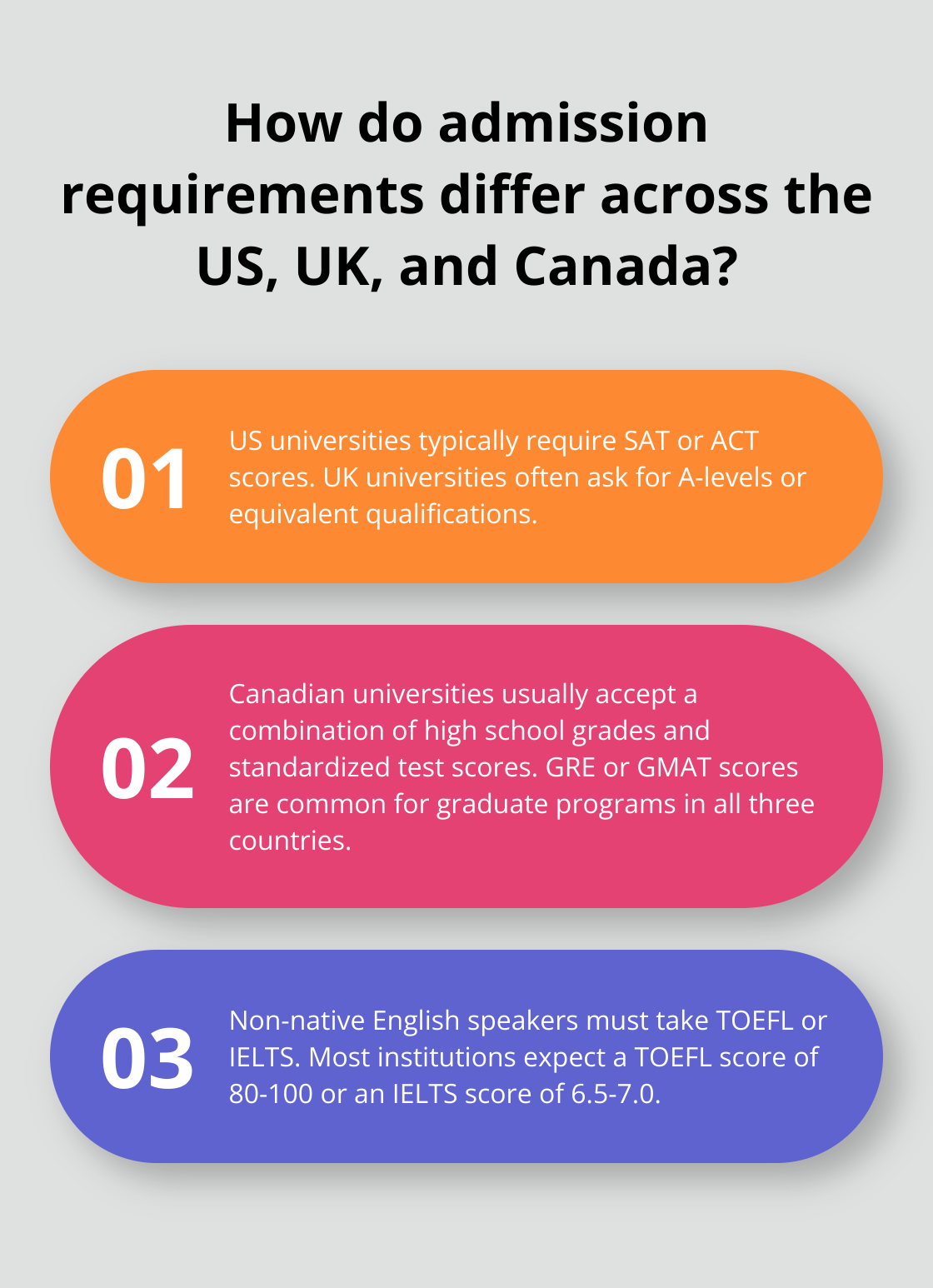
Non-native English speakers must take English proficiency tests like TOEFL or IELTS. Most institutions expect a TOEFL score between 80-100 or an IELTS score of 6.5-7.0 (though specific requirements may vary).
Crafting a Compelling Application
Transcripts form the foundation of your application. If your transcripts are not in English, obtain official translations. For US applications, a GPA of 3.0 or higher on a 4.0 scale will enhance your competitiveness.
Essays or personal statements play a vital role, particularly for US and UK applications. These should showcase your unique experiences, academic interests, and future aspirations. Avoid generic content – admissions officers want to see your authentic personality.
UK applications through UCAS limit personal statements to 4,000 characters. Make each word count by emphasizing your passion for the subject and relevant experiences.
Timing Your Application
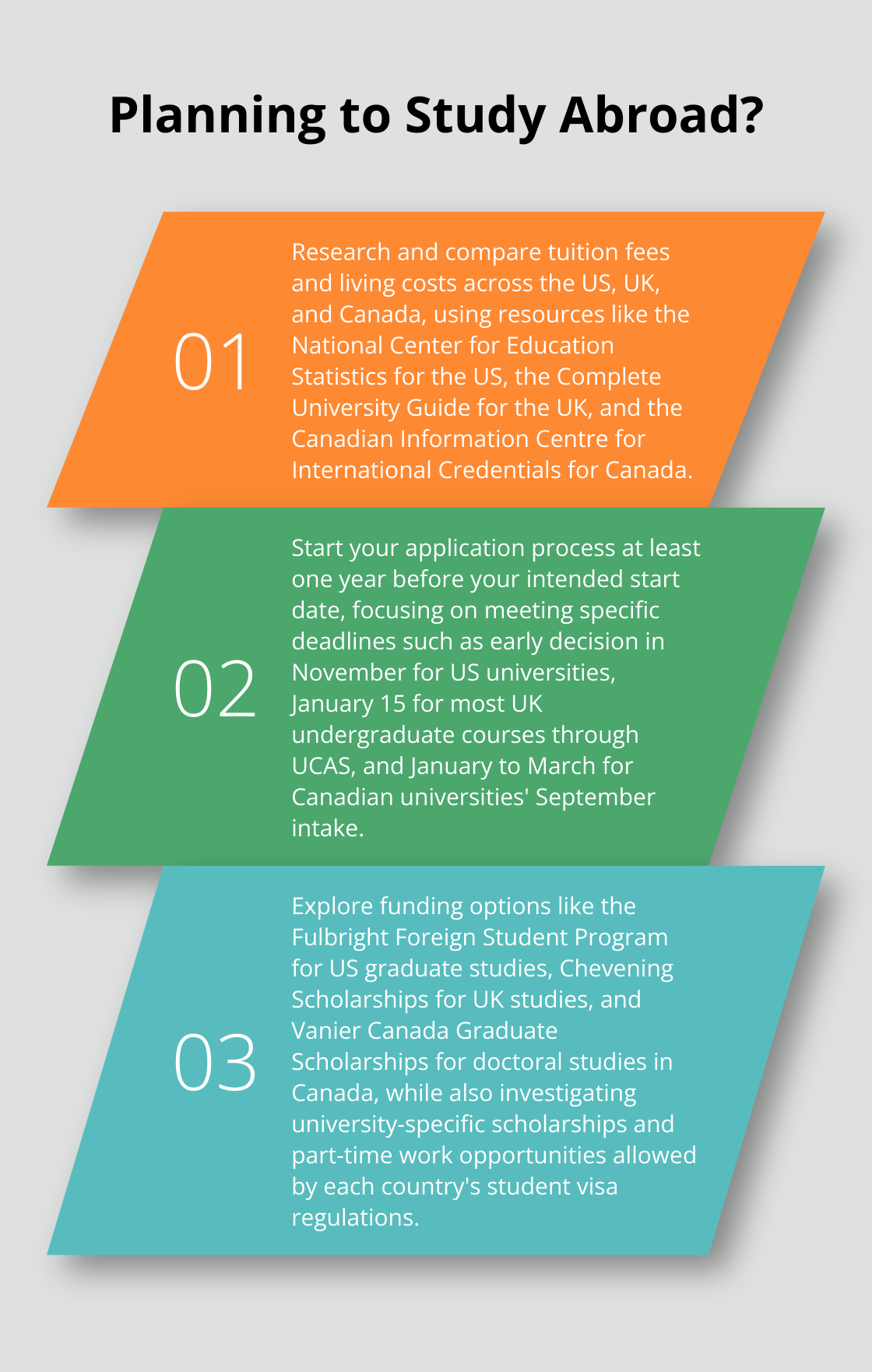
Application deadlines differ significantly. For fall admission in the US, early decision deadlines typically fall in November, while regular decision deadlines occur between January and March. UK universities set a January 15 deadline for most undergraduate courses through UCAS. Canadian universities often have deadlines between January and March for September intake.
Start your application process at least a year before your intended start date. This timeline allows you to complete required tests, gather documents, and create thoughtful essays.
Securing Strong Recommendations
Letters of recommendation hold significant weight (especially in US applications). Select recommenders who know you well academically or professionally. Provide them with your resume and a brief outline of your goals to help them write more effectively.
Ask for letters at least a month before deadlines. Some recommenders might need gentle reminders, so follow up respectfully.
Navigating the Process with Expert Help
The application process can seem daunting, but expert guidance can streamline your journey. Services like Excel Beyond Borders offer specialized assistance to increase your chances of admission to top institutions across these countries. With personalized support, you can navigate complex requirements and present your strongest application.
As you prepare to embark on your international education journey, the next crucial step involves understanding how to finance your studies abroad. Let’s explore the various options available to make your dream of studying in the US, UK, or Canada a reality.
How Much Does Studying Abroad Really Cost?
Breaking Down the Expenses
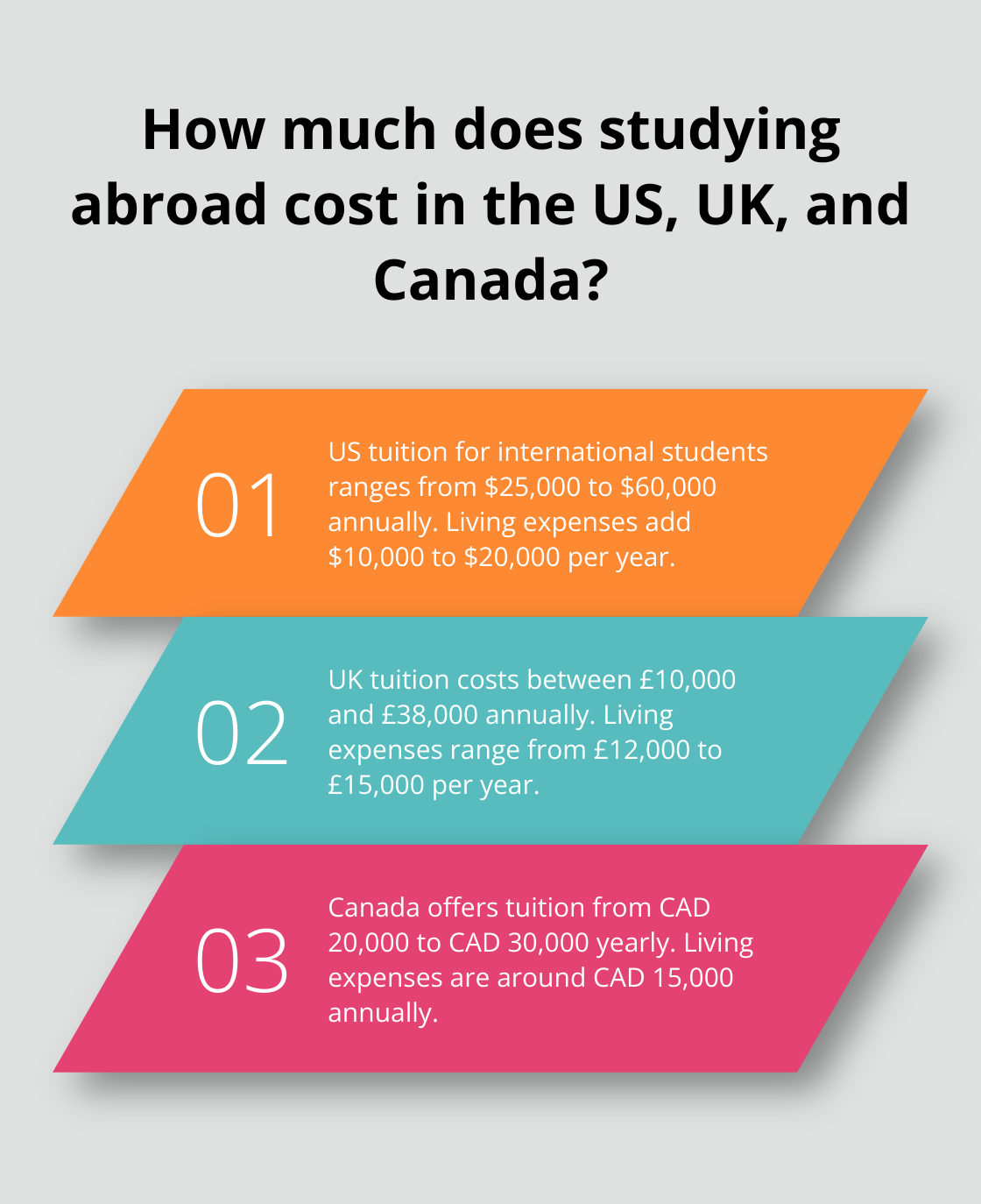
Studying in the US, UK, or Canada requires a significant financial investment. The US demands the highest fees, with annual tuition for international students ranging from $25,000 to $60,000. Living expenses add another $10,000 to $20,000 per year. The UK proves slightly less expensive, with tuition between £10,000 and £38,000 annually, plus living costs of £12,000 to £15,000. Canada offers more affordable options, with yearly tuition from CAD 20,000 to CAD 30,000 and living expenses around CAD 15,000.
Students often overlook hidden costs. You should budget for health insurance (mandatory in all three countries), textbooks, technology fees, and travel expenses. These additional costs can significantly impact your overall budget.
Funding Your International Education
Scholarships provide an excellent way to finance your studies abroad. The Fulbright Foreign Student Program offers full funding for graduate studies in the US. UK’s Chevening Scholarships support outstanding students from around the world. Canada’s Vanier Canada Graduate Scholarships provide $50,000 per year for doctoral studies.
Many universities offer their own scholarships for international students. The University of Toronto Lester B. Pearson International Scholarship covers tuition, books, incidental fees, and residence support. You should always check with your prospective universities for institution-specific opportunities.
Government-backed loans in your home country may provide another option. For instance, Indian students can explore the SBI Global Ed-Vantage Scheme, which offers loans for full-time regular courses at foreign colleges/universities.
Earning While Learning
Part-time work can help offset living expenses. In the US, F-1 visa holders can work up to 20 hours per week on campus during term time. The UK allows international students to work up to 20 hours per week during term time and full-time during holidays. Canada proves the most generous, permitting students to work up to 20 hours per week off-campus during term time and full-time during scheduled breaks.
Work-study programs in the US provide part-time jobs for students with financial need. The UK doesn’t have a formal work-study program, but many universities offer part-time campus jobs. In Canada, the Student Work Placement Program supports students in finding paid work experience related to their field of study.
Navigating Financial Challenges
Financial planning for international education can seem daunting. However, expert guidance can simplify this process. Services like Excel Beyond Borders offer specialized assistance in securing scholarships, navigating loan processes, and exploring work opportunities. Such services (which often come with a fee) can help you find the most cost-effective path to your international education goals.
Making Informed Financial Decisions
You should weigh the costs against potential benefits when deciding to study abroad. Consider factors such as the quality of education, career prospects, and personal growth opportunities. Research thoroughly and create a detailed budget that accounts for all expenses. This approach will help you make an informed decision about your international education investment.
Final Thoughts
International education transforms lives through personal growth, academic excellence, and career advancement. Students who plan to study in the US, UK, or Canada must evaluate their goals, research institutions, and prepare strong applications. The process requires attention to detail, from crafting compelling essays to securing impactful recommendation letters.
Financing education abroad involves careful consideration of tuition fees, living expenses, and funding sources. Students should explore scholarships, work-study programs, and part-time employment options to support their studies. A comprehensive budget must account for all expenses, including health insurance and travel costs.
Excel Beyond Borders offers expert assistance in navigating the complexities of international education. Their services can help students make informed decisions and present their strongest applications. Students who take the first step towards their international education goals today will shape their personal and professional lives for years to come.